An Engineering Problem that Required the World’s Largest Spanner Bar
Standard solutions don’t always fit large-scale construction projects.
When a BZI project required installing structural trusses approaching 400 feet long, it was a challenge that off-the-shelf equipment couldn’t solve. BZI’s R&D arm, InnovaTech, engineered a solution.
Here’s what the BZI team was up against:
- Lifts to be completed: 11
- Crane: Liebherr LR 11000 (1,000-ton class), one of three cranes on the project
- Pick points: 4 per truss
- Placement tolerance: +/- 1/4″
- Site constraints: ground assembly of the main trusses and box trusses in a confined area, plus site layout and crane paths
Engineered Around the Problem
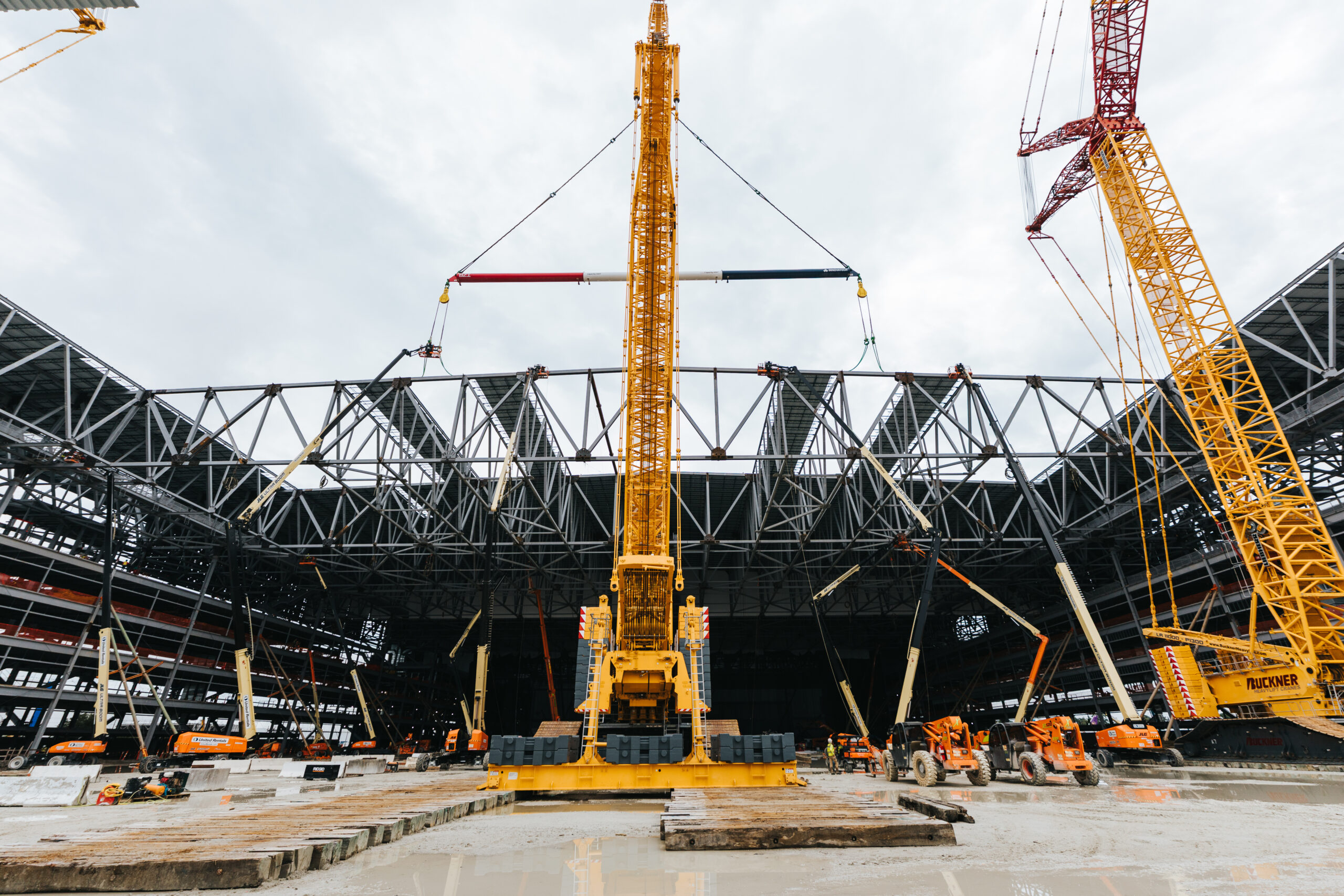
InnovaTech engineers and builds bespoke solutions to solve problems BZI teams encounter in the field. For this project, that meant developing a spanner bar capable of handling trusses at an extraordinary scale. The result was SpanMaster, a 180-foot-long spanner bar with the capacity to lift up to 310 tons.
SpanMaster needed to lift trusses measuring approximately 390 feet long, longer than a football field from end zone to end zone. And lifting a structure this large needed to account for more than weight.
Consideration for the relationship between the truss, cranes, rigging, and jobsite conditions, as well as how the component would be positioned and finally installed, shaped the design of SpanMaster from the beginning.
By adapting a standard piece of equipment to execute an unconventional lift and engineering equipment around the problem, InnovaTech demonstrated how bespoke engineering is invaluable on projects of this scale.
From Concept to Jobsite
SpanMaster is just one example of how InnovaTech works within the larger BZI organization. The team has direct access to the people designing, fabricating, and erecting BZI projects, giving its engineers a close view of the challenges that equipment ultimately needs to solve. The team isn’t limited to developing standardized products or solutions that fit neatly into an existing category.
When a project presents a problem that requires something different, InnovaTech can work backwards from the requirements and develop the equipment to meet them.
- Development time: design started around mid-August 2025, roughly nine months before the first lift
- Load testing: SpanMaster was proof tested up to 770,000 lbs. before the first lift
- Engineering: designed in SolidWorks, with Siefert Associates running their own simulations
An operation of this scale requires extensive modeling and pre-planning long before BZI arrives on site. The team must work through the details in advance, accounting for the lift requirements, equipment positioning, sequencing, and logistics needed to execute the operation safely and efficiently.
Once operations begin, that preparation translates into constant coordination across the entire team. Cranes, forklifts, and boom lifts must work in sync with rigging experts and fitters responsible for installing the bolts that secure the assembly. Clear communication and precise timing keep each part of the operation moving together, allowing the team to manage a complex lift with the level of control it demands.
SpanMaster is a significant engineering achievement, but executing an operation of this magnitude takes more than specialized equipment. It takes detailed planning, technical expertise, and a team that can coordinate every moving part from preparation through the final assembly.
For hyperscale and other large-scale projects, that capability matters. Having an engineering team working directly with those challenges gives BZI the advantage when solving them.